5 Sustainable Fashion Books To Read in 2026
Sustainable fashion has moved far beyond just shopping for organic cotton. It's now a deep, systemic critique of power, labor, colonialism, and design itself. If you're ready to move past surface-level solutions and understand the roots of the industry's problems, and the bold ideas for fixing them, these five essential books are your guide for 2026.
The Anti-capitalist Book of Fashion by Tansy E. Hoskins
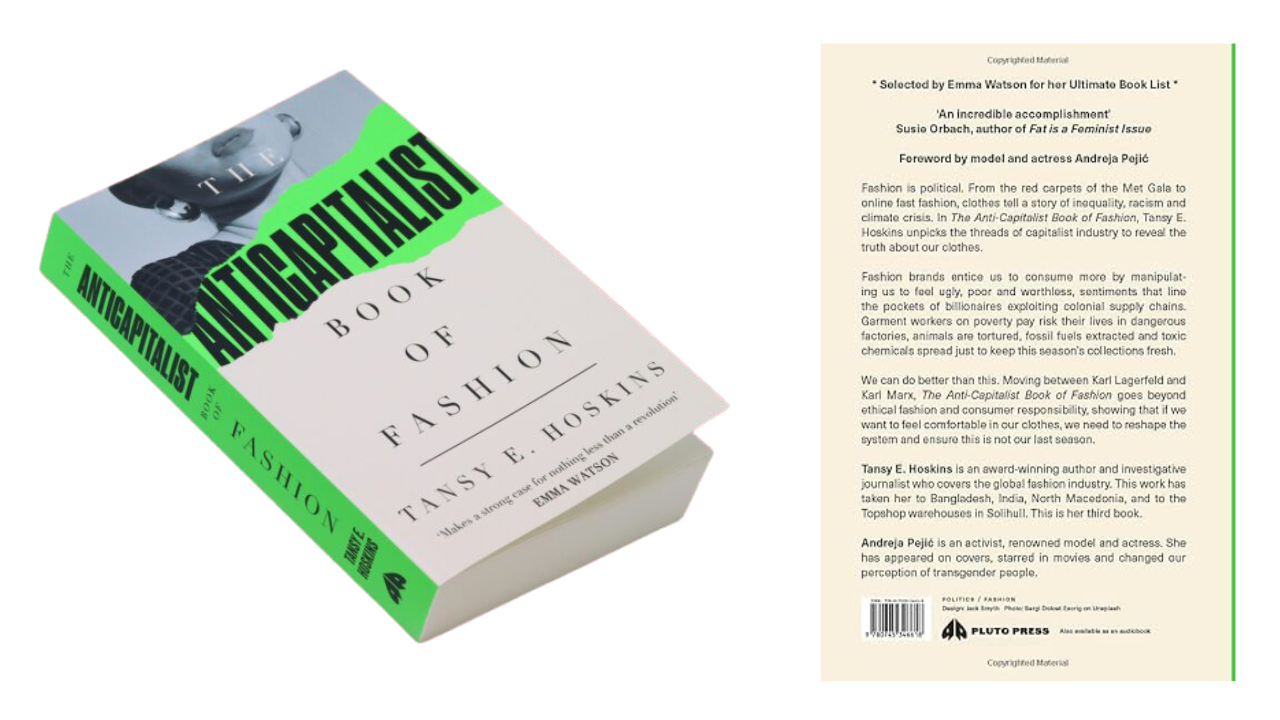
Forget the glamour; this book argues that fashion is a powerful political force built on exploitation. Tansy E. Hoskins powerfully explains how the industry deliberately makes us feel insecure to drive endless consumption, enriching billionaires at a massive human and planetary cost. She connects the dots between luxury runways and deadly factory collapses, showing how colonial supply chains, animal cruelty, and toxic pollution are baked into the system.
This isn't a guide to "better" shopping, but a manifesto arguing that ethical consumerism alone can't fix a fundamentally broken model. Hoskins uses the lenses of both Karl Marx and Karl Lagerfeld to make a compelling case that true comfort in our clothes will only come from a complete and radical redesign of the economic system itself.
2. Global Perspectives on Sustainable Fashion by Alison Gwilt, Alice Payne, Evelise Anicet Ruthschilling
This book corrects a major flaw in the sustainability conversation: the idea that one solution fits all. Instead, it presents a truly global view, examining how different regions tackle fashion's challenges based on their unique cultures, environments, and local needs. The book is structured around six key world regions, featuring essays and spotlight sections that highlight specific design innovations and community projects from each area. Filled with photographs, infographics, and case studies, it makes the global landscape visual and understandable. You'll see how sustainable fashion looks entirely different in Scandinavia compared to South America or Southeast Asia. Ultimately, it argues that for sustainability to be effective, it must be culturally relevant and locally led, not a top-down directive from fashion's traditional capitals.


3. Fashion and Postcolonial Critique by Elke Gaugel and Monica Titton (Eds.)
This collection of essays provides a crucial framework for understanding fashion’s deep entanglement with histories of empire and colonization. It argues that to truly critique the global fashion system, we must examine how colonial domination, resistance, and ongoing power imbalances shape what we wear and how we see it.
The book brings together diverse voices from fields like anthropology, art history, and cultural studies to analyze fashion as a political and social phenomenon. It investigates how stereotypes are perpetuated, how cultural heritage is appropriated, and how the industry maintains global inequalities.
By applying a "postcolonial lens," this book challenges the dominant Western narrative of fashion history and offers tools for a more nuanced global understanding of fashion and its meanings.
4. Strategizing Against Sweatshops by Matthew S. Williams

This book is a fascinating case study in effective activism, chronicling the powerful impact of the United Students Against Sweatshops (USAS) movement. Williams details how American college students became a formidable force for global labor rights by targeting their own universities' lucrative partnerships with brands like Nike and Adidas. The strategy was smart: they pressured schools to adopt strict ethical codes of conduct for apparel, leveraging university contracts to demand better conditions for overseas garment workers. The book provides an innovative model of how social movements can strategize and adapt to their political environment to create real change. It shows that activism isn't just about protest, but about building smart campaigns that hold power accountable, proving that campuses can be critical launching pads for global justice.
5. A Practical Guide to Sustainable Fashion by Alison Gwilt
This is the essential hands-on manual for anyone involved in the actual process of creating fashion. Alison Gwilt breaks down the entire lifecycle of a garment, providing designers with clear, step-by-step methods to assess and minimize their environmental impact at every stage. The book is packed with concrete techniques, from designing with low-impact textiles and zero-waste patterns to implementing repair services and closed-loop recycling systems. It highlights real-world examples from pioneering brands like Stella McCartney and People Tree, turning theory into actionable practice. Whether you're a student, a designer, or an entrepreneur, this guide translates the big ideas of sustainability into the practical choices made on the drawing board, in the sampling room, and in the business plan.
